
Woking Borough Council had 1,239 households on its housing register in April and granted 120 long-term tenancies in 2025/26. Councillors discuss it on 24 Nov.
There were 1,239 households on Woking Borough Council’s housing register on 1 April 2026. In the year to March, the council granted 120 long-term tenancies in its own homes.
The figures are in the council’s annual lettings report, published on Monday for its Communities and Housing Scrutiny Committee on Tuesday 24 November (Woking Borough Council, Annual Report 2025/26: Housing Allocations, Lettings and Tenancy Sustainment). The council says the two numbers “are not directly comparable”, but that they “demonstrate the scale of pressure on available housing stock”.
Who is waiting, and for what
The report’s appendix breaks the register down by the size of home each household needs:
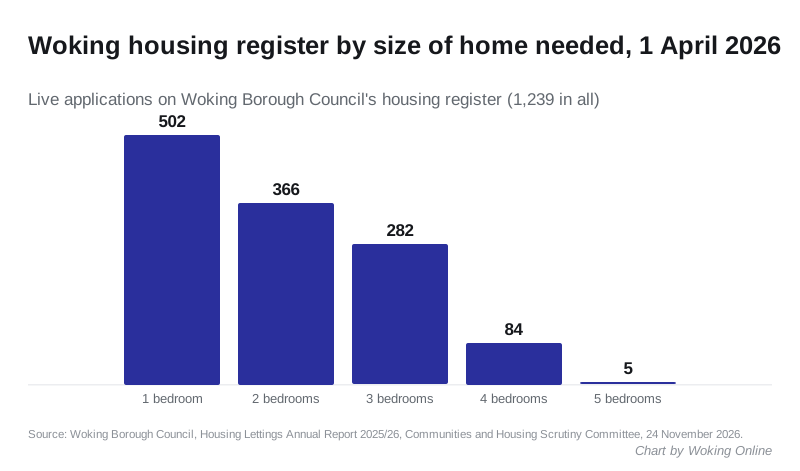
One-bedroom homes are the biggest need, at 502 households or 40.5% of the register. The longest waits are for larger family homes, which the council puts down to limited supply and high demand.
The council places each household in a priority band, from A for emergencies to D for low or reduced need:
| Band | Households | Share |
|---|---|---|
| A (emergency) | 13 | 1% |
| B | 71 | 6% |
| C | 403 | 33% |
| D (low or reduced need) | 752 | 61% |
Other figures from the register:
- 1,002 households need general needs housing.
- 294 are in housing need because they are overcrowded.
- 54 are waiting for sheltered housing, which has the shortest waits.
- 40 want to downsize.
- 11 are waiting for extra care housing.
Where the homes went
The council signed 192 new tenancy agreements in its own homes in 2025/26. That count includes homes used temporarily for homeless households and moves by existing tenants. More than half were studios or one-bedroom homes.
Of the 120 long-term tenancies:
- 58% went to new tenants from the housing register
- 18% went to existing council tenants transferring
- 15% came through mutual exchanges, where tenants swap homes
Homelessness was the reason for 49 of the long-term lettings, the largest single reason. The council also used 62 of its ordinary homes as temporary accommodation for homeless households, on licence agreements.
Eight tenancies got wrong
Over the summer, managers checked all 192 new tenancies to see whether each tenant had been given the right type of tenancy under the council’s 2013 Tenancy Policy. Eight failed, about 4%:
- Five had the wrong agreement. Three should not have included an introductory period, and two should have been secure tenancies rather than flexible ones.
- Two were recorded in the wrong category on the council’s system, though the tenancy itself was correct.
- One tenancy agreement was missing from the system or corrupted.
The report says these are being corrected, “in consultation with the tenant where required”. It found no trend among the failures, but says quality checks will now be brought in.
Tenancy management was one of the two areas where the Regulator of Social Housing found serious failings when it graded the council C3 on 28 October. A separate report to the same meeting says the council’s Housing Improvement Programme has been rewritten in response, as an 18-month plan.
Flexible tenancies to be phased out
Most new council tenants in Woking are offered a seven-year flexible tenancy, usually after a one-year introductory period. Secure tenancies go to people who already hold one, people moving into sheltered or extra care housing, and people with a lifelong health condition.
The report says a new Tenancy Management Policy is due by the end of 2026. It is “expected to phase out Flexible Tenancies”. The council also plans a light refresh of its Housing Allocations Policy and a new tenant handbook.
Support to stay put
The council’s Floating Support team took 139 referrals in 2025/26 and closed 124 cases. The most common outcome was that the tenant kept their home or avoided eviction, in 46 cases. None of the closed cases ended in eviction. Others ended with a move: 24 into social housing, 19 into temporary accommodation, 19 into bed and breakfast and 13 into hotel accommodation.
The Independent Living Service supports around 320 tenants, 269 of them in sheltered housing, with about 1,000 visits a month.
What it means for you
- If you are on the register, most households are in Band D. Waits are longest for homes with three or more bedrooms and shortest for sheltered housing.
- If you hold a flexible tenancy, nothing changes yet. The report says only that the new policy, due by the end of 2026, is expected to phase flexible tenancies out.
- If your tenancy started in 2025/26, the council says it is contacting tenants where a correction needs their involvement.
- The committee meets at 7pm on Tuesday 24 November. The report goes to the council’s Resident and Landlord Partnership panel on 18 November first.
Sources
- Woking Borough Council: Communities and Housing Scrutiny Committee, 24 November 2026, agenda and reports, published 16 November 2026: Annual Report 2025/26 on housing allocations, lettings and tenancy sustainment (CHSC26-020) and its appendix, the Housing Lettings Annual Report 2025/26; Results of Housing Regulatory Inspection (CHSC26-017)
Have your say