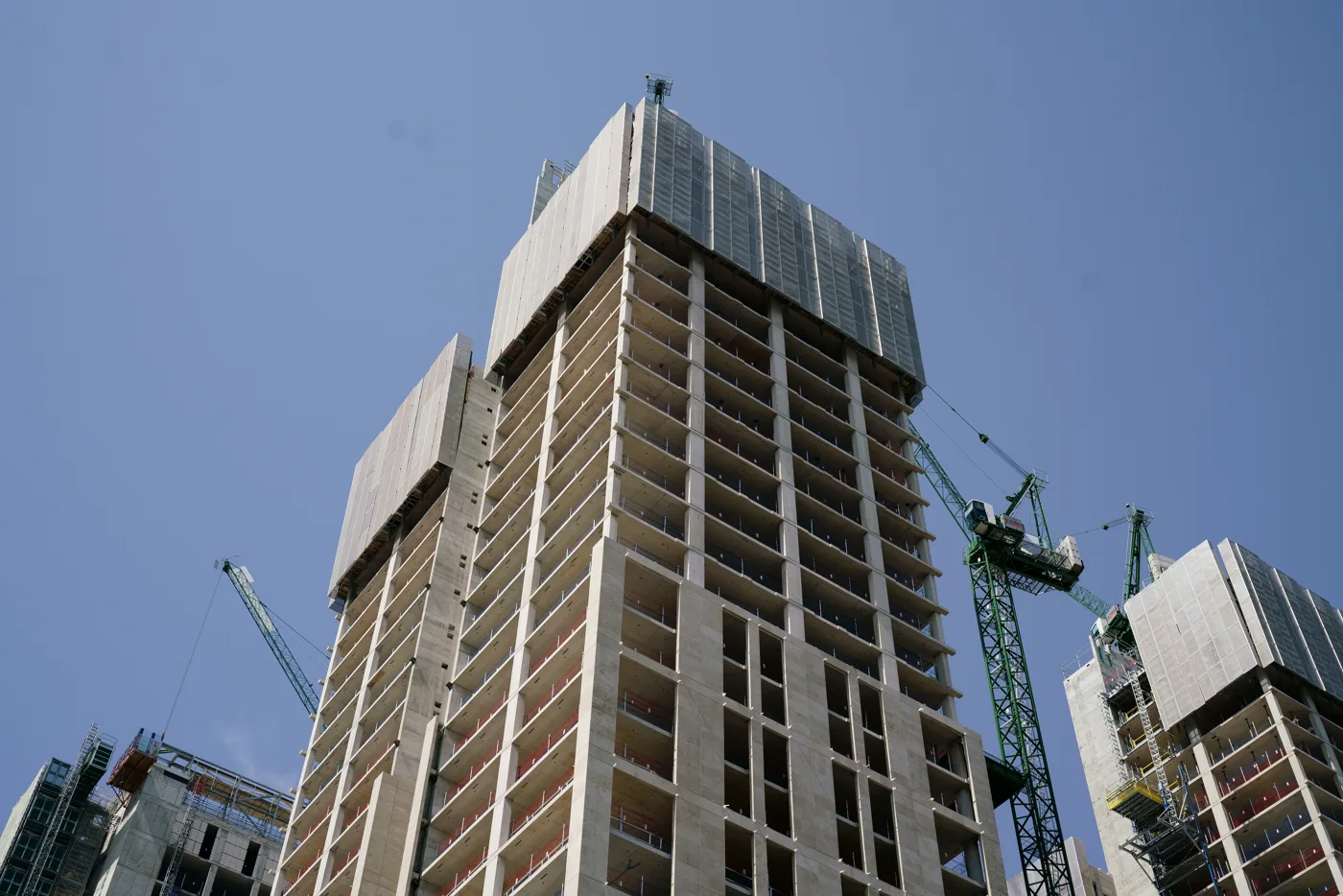

How to search Woking planning applications on the council's Public Access portal, read the weekly list, comment within 21 days and speak at committee.
Every one of the Woking planning applications submitted in the borough, from a rear extension in Knaphill to a twenty storey tower in the town centre, sits on one free public register that anyone can search without an account. Most people only discover a scheme once the hoardings go up, by which point the window to say anything useful has closed. This guide covers where the register is, how to read a reference number, how long you actually get to comment, what the council will and will not take into account, and how to claim the right to speak in front of the Planning Committee.
Where Woking planning applications live
The council runs an Idox Public Access portal, and it is the single place everything lands:
No login is needed to look. You get the drawings, the officer reports, the consultation dates, the case officer and any comments already submitted. The council asks you to agree to a copyright notice before searching, which reflects that plans and drawings remain protected under the Copyright, Designs and Patents Act 1988: you may download and print them for consultation purposes, but not copy them further without the copyright owner’s permission (review or comment on an application).
If you would rather not run a search at all, open the weekly list and pick a week. It shows everything validated or decided across the borough in that week, and you can narrow it to a single ward: Byfleet and West Byfleet, Canalside, Goldsworth Park, Heathlands, Hoe Valley, Horsell, Knaphill, Mount Hermon, Pyrford or St Johns.
How to read a Woking reference number
Woking references carry a prefix that tells you what kind of case it is before you open anything. Taking real examples from a single recent week:
PLAN/2026/0553, a full planning application, in this case a single storey rear extension in Woking.TREE/2026/8182, works to trees, here a crown reduction to a mature oak.COND/2026/0089, approval of details reserved by condition on an earlier permission.
The four digit block is the running number for the year, so PLAN/2025/0905 is a 2025 case still working through the system. If you only know the address, the property search will find it without the reference.
Searching the portal, step by step
- Open caps.woking.gov.uk/online-applications and accept the copyright notice.
- Use Simple Search for a quick look, or Advanced Search to filter by ward, date range or application type.
- To see the history of a specific address, use the Property tab in Simple Search, enter the postcode and pick the property from the list. That gives you every application ever made there, which is the check to run before you buy.
- Open a case and use the Documents tab for drawings and reports, and the Comments tab for representations.
- Note the case officer, the target decision date and the consultation deadline on the summary page.
Registering a free account is worth two minutes of your time. It lets you save a search, typically your street, postcode or ward, and be emailed when anything new matches, and it lets you track individual applications. Setting that up once beats remembering to check the weekly list every Monday, which nobody does for long.
How long you get to comment
You get a statutory 21 day consultation period. The council is specific about the mechanics: the online comments facility on Public Access is open for those 21 days and then closes. Comments received during that window are all considered (review or comment on an application).
Once the online facility has shut, you have not necessarily missed your chance. The council states that comments made after it closes can still be submitted by post or email, and in practice a case officer will take account of points that arrive before the decision is made. It is far better not to test that, though: the deadline shown on the application page is the one to work to.
Not everyone gets a letter. Neighbours in the immediate vicinity are usually notified directly, and larger or more sensitive schemes also get a site notice and sometimes a press notice. The council publishes its publicity and neighbour notification approach alongside its description of the process.
What actually counts in a comment
Two things determine whether an objection carries weight: what it says, and whether it says it in planning terms.
A planning decision can only turn on material planning considerations. Points that carry weight include the effect on neighbours’ light and privacy, highway safety and parking, design and the character of the area, noise, loss of trees or green space, drainage and flooding, and conflict with the council’s planning policies. Points that carry little or none include loss of a private view, the effect on your property’s value, competition with an existing business, and who the applicant is.
Three practical rules from the council’s own guidance:
- Your comment becomes public. Comments submitted online appear on the Comments tab, and all comments can be read on the Documents tab.
- Abuse is removed. Anything offensive or discriminatory will be taken down and disregarded when the application is determined.
- Quality beats volume. A handful of specific, policy grounded objections generally does more than a hundred identical copy pasted ones, though the raw count does matter for one particular reason, explained below.
Who decides, and how long it takes
Most applications never reach a politician. They are determined by planning officers under delegated authority, and the council says decisions on most applications usually take six to eight weeks. A case officer is assigned when the application arrives, carries out a site visit, and will discuss changes with the applicant or their agent before recommending approval or refusal (about the planning process).
The rest go to the Planning Committee, which meets roughly every four weeks in public and is webcast. Recent meetings have run on 10 February, 10 March, 14 April, 2 June and 14 July 2026, with the next scheduled for 1 September 2026 and an extraordinary meeting on 15 September. Agendas, reports and minutes are all published on the council’s Planning Committee page.
The July 2026 agenda gives a fair sense of what reaches committee rather than being decided by an officer: Briarwood Nursery at 145 Saunders Lane, 46 Cavendish Road, and Nottingham Court on Robin Hood Road in St Johns were all listed for determination. Each can be looked up by reference or address on the portal.
If you want an enquiry answered on a live application, it goes to the case officer named on the portal, or you can ring the planning team on 01483 743 843.
The right to speak at committee
This is the part most residents do not know exists. Woking allows objectors to speak at Planning Committee, but only where the case meets one of its criteria (the right to speak at a planning committee).
You qualify if the application on the agenda has attracted 10 or more individual objections before the point 14 days ahead of the meeting. A petition counts as one objection, not many, which is why ten separate letters beat one sheet with a hundred signatures. You also qualify regardless of the objection count where the application raises major policy issues, requires an environmental statement, is major commercial development over 2,500 square metres, or is residential development of more than 50 dwellings.
The mechanics are strict. Register by leaving a message on the member services answerphone on 01483 743 014, quoting the application reference and your contact details. The line is open from 9am the day after the agenda is published until 4pm on the Monday before the meeting. Only one objector speaks, chosen first come first served, and others are asked to combine their points with that person. At the meeting the objector speaks first, then the applicant or agent, with three minutes each. If the objector’s representative does not turn up, the applicant does not get to speak either.
Enforcement: when work happens without permission
If a building goes up that you do not think has permission, or a condition is being ignored, the council keeps a searchable Register of Enforcement Notices covering notices served since 1955, including listed building enforcement notices, stop notices, temporary stop notices and breach of condition notices. It does not list cases where no notice has been served. The search accepts wildcards, so ENF*00089 or *Princess Road* both work. Reports go to planningenforcement@woking.gov.uk or Planning Enforcement, Woking Borough Council, Civic Offices, Gloucester Square, Woking GU21 6YL.
One change worth knowing about
The authority deciding these applications is being replaced. Under the Surrey (Structural Changes) Order 2026, Woking Borough Council and its neighbours give way to a new West Surrey Council on 1 April 2027 (the council on the transition). Until then nothing on this page changes: applications are still validated, consulted on and determined by Woking Borough Council, on the portal above. What happens to the planning register and the committee structure after vesting day has not yet been published, so watch the shadow authority papers rather than assuming. The bigger strategic picture, the new Local Plan that must find room for 12,656 homes by 2044 and its consultation dates, is covered in our Woking planning news.
Frequently asked questions
How do I find planning applications in Woking?
Search the council’s Public Access portal at caps.woking.gov.uk/online-applications by address, postcode or reference. No account is needed to view. The weekly list shows everything validated or decided in a given week, and can be filtered to a single ward.
How long do I have to comment on a Woking planning application?
Twenty one days, the statutory consultation period. The online comments facility closes at the end of it. After that you can still write by post or email, and points that arrive before the decision is made are normally taken into account, but the published deadline is the one to work to.
Can I speak against an application at Woking’s Planning Committee?
Yes, if the application has attracted 10 or more individual objections at least 14 days before the meeting, or if it raises major policy issues, needs an environmental statement, is commercial development over 2,500 square metres, or is more than 50 homes. Register on the member services answerphone, 01483 743 014, and you get three minutes.
How long does a planning decision take in Woking?
Most applications are decided in six to eight weeks by planning officers under delegated authority. Applications that go to the Planning Committee follow that committee’s cycle, which is roughly every four weeks.
Are comments on Woking planning applications public?
Yes. Comments submitted online appear on the Comments tab of the application, and all comments can be read on the Documents tab. Offensive or discriminatory comments are removed and disregarded.
What do the Woking planning reference prefixes mean?
PLAN is a planning application, TREE covers works to trees, and COND is approval of details reserved by a condition on an earlier permission. The year and a running number follow, as in PLAN/2026/0553.
Sources
- Woking Borough Council, Public Access planning portal and its weekly list
- Woking Borough Council, review or comment on an application, for the copyright notice, the 21 day online comments window, publication of comments and the enforcement register
- Woking Borough Council, about the planning process, for the 21 day consultation, the six to eight week decision period, delegated authority and the four weekly committee cycle
- Woking Borough Council, the right to speak at a planning committee, for the 10 objection threshold, the qualifying application types and the registration process
- Woking Borough Council, Planning Committee meetings, agendas and minutes
- Woking Borough Council, planning for the new Surrey councils
Details were checked against the council’s planning pages and the live portal in August 2026. Consultation deadlines and application statuses change daily, so always confirm on Public Access before relying on a date. Our guides to Woking council tax bands and parking in Woking cover the other council matters residents ask about most, and Woking Online carries the day’s local news.
Have your say