
Woking's new Local Plan must provide for 12,656 homes by 2044, over double the current rate. The consultation closes 16 August; the full timetable to 2029.
The biggest planning story in Woking is not a tower or a car park. It is the new Local Plan, the document that will decide where the borough puts 12,656 homes between 2027 and 2044, roughly two and a half times the pace of building its current plan asks for. The first formal consultation is open now and closes on Sunday 16 August 2026, and the whole process runs on a legally fixed timetable to adoption in April 2029, straddling the abolition of Woking Borough Council itself. Here is what is happening, the numbers behind it, and every date at which you can have a say.
What is happening now
Woking Borough Council launched a five-week consultation on 13 July 2026, the first formal stage of a new Local Plan covering 2027 to 2044. It is a “scoping” exercise: the council wants to know whether it has identified the right priorities across housing, jobs, infrastructure, transport, climate change and the environment before it drafts any policies. It builds on a 2025 visioning exercise in which residents described the Woking they wanted in 2044 (Woking Borough Council).
Councillor Louise Morales, the Portfolio Holder for Planning, put the ask directly: “As we prepare a new Local Plan, we want to hear whether we’ve identified the right priorities for Woking and whether there are other issues we should be considering.” The consultation closes Sunday 16 August 2026, and responses go in online via the council’s page above.
This is also one of the first plans in the country prepared under the government’s new plan-making system, in force since 25 March 2026, which caps the whole process at 30 months and runs it through three formal “gateway” checks (the new Local Plan).
The number that drives everything: 12,656 homes
The council’s published plan data sets the new Local Plan’s housing requirement at 12,656 homes over the 2027 to 2044 period (Woking plan data, June 2026). The current Core Strategy, adopted in 2012, was built around 4,964 homes across its whole plan period, or 292 a year. The new requirement works out at around 740 homes a year, about two and a half times the current rate, in a borough that is the smallest in Surrey by area and mostly built up already, which is why recent growth has gone into town-centre towers rather than green fields.
Two pressures sharpen that number:
- The borough cannot currently show five years of housing land. Its latest position statement puts the supply at 4.57 years (housing land supply). Under national policy, falling short weakens the council’s hand against speculative applications in the meantime.
- The plan must be in place by 2029. The government “expects all areas to have a local plan by 2029”, and an area without an up-to-date plan “is more likely to face speculative development”, as the council’s own pages put it.
The full timetable, and when you get a say
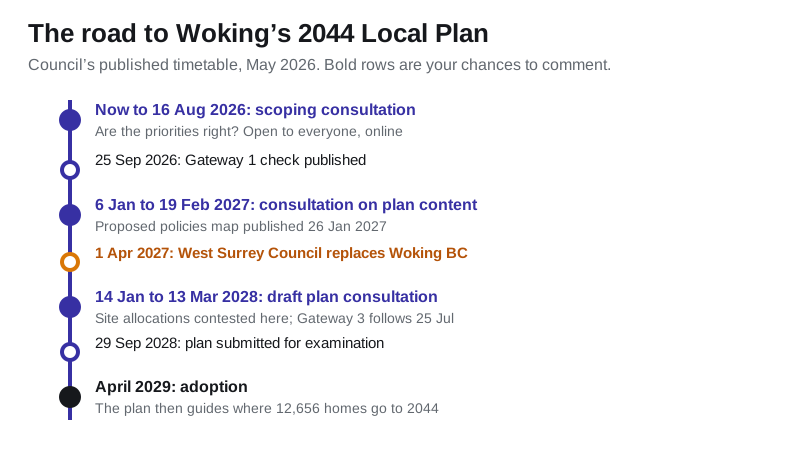
The new system fixes the stages in advance. The council’s published timetable (timetable for the new Local Plan):
| Stage | When |
|---|---|
| Scoping consultation (open now) | 13 July to 16 August 2026 |
| Gateway 1 self-assessment published | 25 September 2026 |
| Consultation responses and council replies published | 30 October 2026 |
| Consultation on the plan's proposed content | 6 January to 19 February 2027 |
| Proposed policies map published | 26 January 2027 |
| Gateway 2 assessment | 26 April 2027 |
| Formal consultation on the draft plan | 14 January to 13 March 2028 |
| Gateway 3 assessment | 25 July 2028 |
| Submission for examination | 29 September 2028 |
| Adoption by full council | April 2029 |
The practical read: this month’s consultation shapes the questions, the January 2027 round shapes the plan’s content, and the January 2028 draft-plan consultation is where site allocations, the maps showing what could be built where, get contested. If a site near you ends up in the plan, the principle of developing it becomes very hard to resist at application stage, so the plan consultations are the moment to engage, not the later planning application.
The council preparing the plan is being abolished
From 1 April 2027, partway through this timetable, a new West Surrey Unitary Authority replaces Woking Borough Council, along with Guildford, Runnymede, Spelthorne, Surrey Heath and Waverley (the council on LGR and the plan). The plan work continues across the handover, and the draft must also be checked for conformity with an emerging Spatial Development Strategy for Surrey during 2028. Until vesting day, nothing changes about who decides applications: Woking Borough Council remains the planning authority, as covered in our guide to Woking planning applications.
The financial backdrop explains why so much rides on the plan being right: the council’s Section 114 notice and roughly £2 billion debt already killed the Victoria Arch widening scheme in 2023, a story we cover in Woking roadworks and travel, and the borough’s capacity to fund infrastructure alongside 740 homes a year will be one of the examination’s central questions.
Byfleet now has its own planning rulebook
One concrete recent decision: residents of Byfleet voted in favour of the Byfleet Neighbourhood Plan at a referendum on 7 May 2026. The plan sets locally written policies on design, the village centre, employment sites, trees and woodland, flood management, local green spaces and heritage, and once formally adopted by councillors it becomes part of the statutory development plan, meaning applications in the Byfleet Neighbourhood Area are judged against it (Woking Borough Council). It is the only made neighbourhood plan in the borough, and a template other communities may look at as the Local Plan advances.
How to follow it, and what to do this week
- Respond to the scoping consultation before Sunday 16 August 2026 via the council’s consultation page.
- Join the council’s newsletter on the same page to be told when each later stage opens.
- Watch the January 2028 draft plan for the site allocations and policies map; that is the consultation with the most at stake for any individual street.
- Day-to-day applications carry on throughout; our planning applications guide covers how to search the register, comment within the 21 days and speak at committee.
Frequently asked questions
How many homes does Woking have to plan for?
The published plan data sets a requirement of 12,656 homes between 2027 and 2044, around 740 a year, against 292 a year under the current Core Strategy (Woking plan data).
When can I comment on Woking’s new Local Plan?
Now, until Sunday 16 August 2026, on the plan’s priorities; then in January to February 2027 on its proposed content; and in January to March 2028 on the full draft plan, before submission in September 2028 (timetable).
When will the new Woking Local Plan be adopted?
The published timetable targets adoption in April 2029, by which point the planning authority will be the new West Surrey Unitary Authority rather than Woking Borough Council.
Does Woking have a five-year housing land supply?
No. The council’s current position statement shows 4.57 years (housing land supply), which strengthens the position of developers bringing forward speculative schemes until the new plan lands.
What is the Byfleet Neighbourhood Plan?
A community-written set of planning policies for Byfleet, backed at referendum on 7 May 2026 and heading for formal adoption. Once made, planning decisions in the Byfleet area must take its policies into account (Woking Borough Council).
Who decides Woking planning applications while the new plan is prepared?
Woking Borough Council, until West Surrey takes over on 1 April 2027. The current Core Strategy and Site Allocations plan remain the development plan until the new Local Plan is adopted.
Sources
- Woking Borough Council, help shape the next stage of Woking’s new Local Plan (consultation dates, Cllr Morales)
- Woking Borough Council, the new Local Plan, its timetable and the LGR page
- Woking Borough Council, local plan data CSV, June 2026 (12,656 and 4,964 housing requirements)
- Woking Borough Council, housing land supply (4.57 years)
- Woking Borough Council, Byfleet Neighbourhood Plan referendum result
Checked against the council’s planning pages on 7 August 2026. The timetable is the council’s published programme and can change as gateways are passed; we will update this page as each stage opens.
Have your say