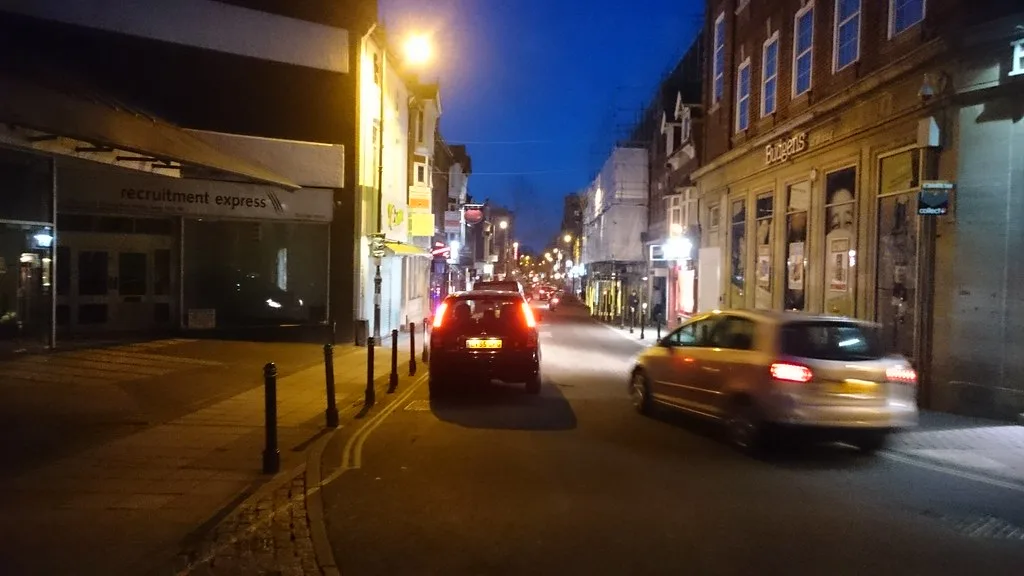

Woking's town-centre curb on new pubs, bars and takeaways, in force since 2007, should be scrapped, council officers say. Surrey Police agrees. Vote on 30 September.
Woking’s town-centre “saturation zone” should be scrapped after 19 years, council licensing officers have recommended. Surrey Police’s borough commander says the zone “no longer appears to be fulfilling the purpose for which it was originally established”.
The Licensing Committee will decide at 7pm on Wednesday 30 September in the Council Chamber at the Civic Offices (agenda). Full Council then has the last word, because the zone sits inside the council’s Statement of Licensing Policy.
What the zone does
The zone is formally a Cumulative Impact Assessment. Inside it, a new premises licence, or a bigger one, is presumed to be refused if anyone makes a relevant objection. The applicant has to show they will not add to the problems of the area. That covers pubs, bars and shops selling alcohol, and also takeaways and restaurants open late.
It was adopted in 2007, after police evidence that alcohol-related crime in the town centre was rising. It was extended on 23 February 2009. Both steps are recorded in the current Licensing Policy 2021-2026 (section 7.7).
The zone covers the core of the town centre, including:
- Chertsey Road, Stanley Road, The Broadway and the High Street
- Victoria Way and Victoria Arch
- Woking station and Station Approach
- Oriental Road from number 13, and Victoria Road
- Goldsworth Road as far as Vale Farm Road, including the supermarket site
- Church Street West and the old market site through to Cawsey Way
Why officers want it gone
The law says a zone can only stay if there is evidence that the number of licensed premises is harming the licensing objectives. Officers say that evidence is no longer there (committee report).
Surrey Police looked at a year of incidents at the town centre’s ten main licensed premises (police response). It counted 268 police-recorded incidents across all ten. The four traditional pubs and bars accounted for 69 of them. Those four are Wetherspoons, O’Neill’s, London Stone and the Junction Tap.
The other six are McDonald’s and Woking Express on Chertsey Road, Woking Superbowl, Tesco on Commercial Way, Marks and Spencer on Victoria Way and Sainsbury’s on Wolsey Walk. The borough commander, Inspector Edward Lyons, wrote that much of the total was shoplifting, anti-social behaviour and welfare concerns. He said many of these were logged because businesses “acted responsibly” in reporting crime, and that high numbers are not a sign of poor management.
He added that the number of traditional licensed premises has fallen. Police demand linked to the night-time economy “has fallen significantly”, he wrote.
What residents said
The council consulted between 4 June and 24 July and received 229 responses. Residents sent 80.3% of them (consultation summary).
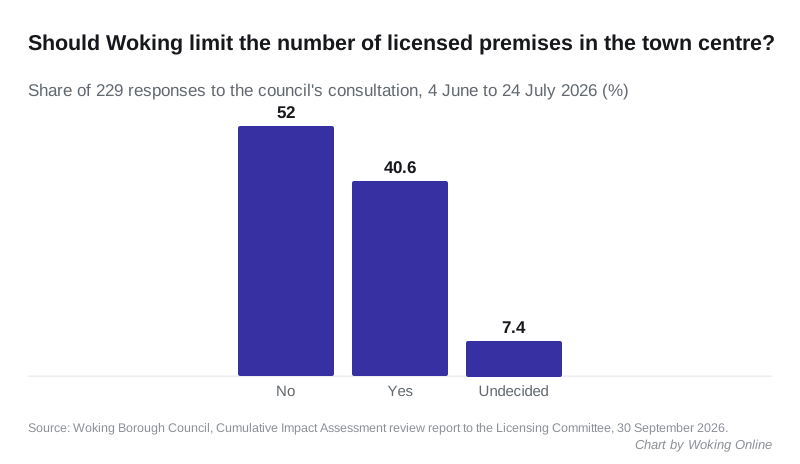
52% opposed restrictions on the number of licensed premises. 40.6% supported them and 7.4% were undecided. Most people thought the town had about the right number of pubs, bars and restaurants, or too few.
The problems people did report were:
- litter, with takeaway packaging singled out
- anti-social behaviour
- street drinking, often of alcohol bought in shops
- noise
- public safety late at night
About a third said they had seen none of these. Several drew a line between the behaviour of individuals and the running of licensed venues. “We need business in Woking. We have too many empty units. There is no vibrancy in our nightlife,” one wrote.
What it means for you
- If you run or plan a venue in the town centre: without the zone, a new licence or a variation is judged on its own merits, as it is anywhere else in the borough. Objections still send it to a committee hearing.
- If you live nearby: you keep the right to object to any application, and to ask for a licence to be reviewed. The council keeps its powers to refuse, add conditions and enforce (committee report, section 5).
- On street drinking: the police response points to the town centre Public Spaces Protection Order as the tool for anti-social behaviour. Its consultation closed in April and the council says its recommendations have been agreed.
The committee has two choices. It can keep the zone and publish a revised assessment, or it can drop it and publish a statement giving its reasons. The current licensing policy expires on 14 October 2026. Full Council meets on 15 October.
The same meeting will also consider the final Statement of Licensing Policy 2026-2031, which drew one consultation response, and a new taxi and private hire policy. The taxi policy drew six. There is more on both in our council week.
A note on our earlier report
On 19 August we reported, from the council’s draft licensing policy, that Woking “does not currently operate” a Cumulative Impact Assessment. The draft does say that, at paragraph 1.6, and the final version going to committee repeats it. The council’s own current policy and this week’s committee report both show the zone has been in force since 2007. Our earlier story now carries a correction.
Sources: Woking Borough Council Licensing Committee papers for 30 September 2026, published 22 September; Surrey Police response by the Woking borough commander (Appendix B); Woking Borough Council Licensing Policy 2021-2026.
Have your say