
From 28 October, officers can fine people £100 for street drinking, masked anti-social behaviour and intimidation in Woking town centre. What the rules cover.
New rules against anti-social behaviour in Woking town centre take effect on Wednesday 28 October. From that day, officers can order people to stop drinking, hand over alcohol or remove a face covering. Anyone who refuses without a reasonable excuse can be given a £100 fixed penalty notice.
Woking Borough Council announced the date today. The Public Spaces Protection Order runs until 27 October 2029, unless it is extended, varied or discharged earlier. New signs are going up across the area now.
What the order covers
The council’s page for the order sets out three rules. Each applies when behaviour causes, or is likely to cause, harassment, alarm or distress.
- Drinking: an authorised person can tell you to stop drinking and to hand over alcohol, sealed or open, if they reasonably believe your behaviour is causing or contributing to anti-social behaviour.
- Face coverings: you must not cover your face to hide your identity while taking part in anti-social behaviour. An officer can ask you to remove it only as far as needed to confirm who you are or to stop further trouble.
- Behaviour: you must not behave in a way that causes harassment, alarm or distress. An officer can direct you to stop.
The council lists what counts as that behaviour:
- threatening, intimidating or aggressive behaviour
- abusive or targeted offensive language
- groups that stop people using or passing through the area safely
- persistent or deliberate behaviour that stops people enjoying the area safely
- behaviour that creates fear, nuisance or disorder
- reckless or dangerous riding of bicycles, e-scooters or similar
Who it does not affect
Drinking is not banned outright. The alcohol rule does not apply:
- in a pub, bar or restaurant, or its licensed outdoor seating
- at an event running under a temporary event notice
- anywhere drinking is otherwise permitted by law, or that the council has exempted
- while travelling through in a vehicle
The face covering rule does not apply to coverings worn for religious or cultural reasons, for medical or disability-related reasons, as protective equipment or for work, at an authorised event such as a festival or parade, or under the direction of the police or emergency services.
Where it applies
The order covers the town centre, not the whole borough. The council’s July report to its Executive describes the boundary as the area enclosed by:
- Victoria Way
- Chertsey Road, as far as the roundabout by Brookhouse Common
- the town-side approach to the station along Maybury Road, to the junction with Stanley Road
- Heathside Crescent, on the other side of the station
The exact line is on the council’s boundary map. The report says the area was drawn wide on purpose. Smaller orders in the past tended to push the problem into nearby streets.
Fines and who enforces them
Council officers, police officers, police community support officers and anyone the council authorises in writing can enforce the order.
The enforcement strategy published with the July report names Surrey Police as the main enforcer. It sets out the penalties:
| What happens | Amount or step |
|---|---|
| Fixed penalty notice | £100, to be paid within 14 days |
| Paid within 10 days | £75 |
| Not paid | a final reminder, then possible prosecution |
| Convicted in court | a fine of up to £1,000 |
Payment by instalments is not accepted. Under the same strategy, someone under 18 is not fined on a first breach. The council sends a formal warning letter and tells their parents or guardians. A second breach brings a visit from a neighbourhood or youth officer. A fine by post is considered only on a third.
Fines are paid on the council’s fixed penalty page, which already lists breaking a PSPO as an offence.
Why the council brought it in
Woking town centre has had a series of these orders over the past decade. The last one expired in February 2025, when the report says the problems appeared to have eased and there was not enough evidence to renew it.
The report gives these reasons for a new one:
- Surrey Police raised concerns, and the multi-agency Joint Action Group proposed the order.
- Police have used dispersal orders in recent months, serving more than 50 dispersal notices.
- Thirteen businesses, plus the head of security for Woking Shopping, gave Surrey Police formal statements on the impact of anti-social behaviour.
The report also set out how recorded crime changed between March 2024 and March 2026:
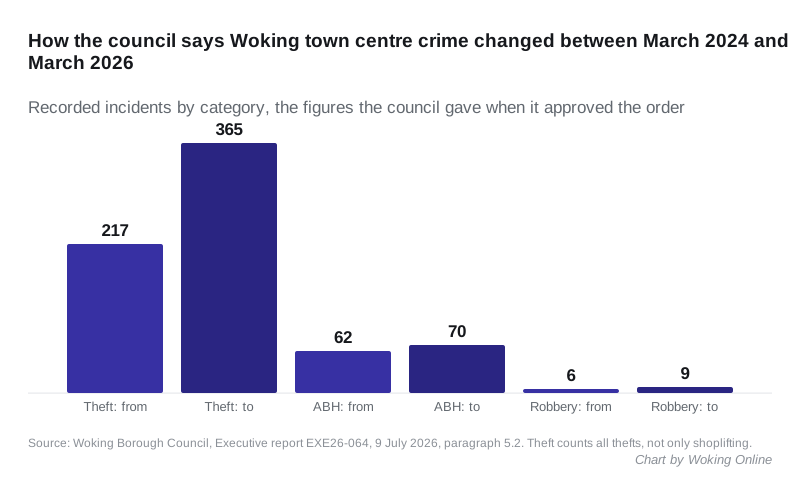
The report adds a caveat. Surrey Police stepped up patrols in the town centre from summer 2025, aimed at shoplifting and anti-social behaviour and partly paid for by national hotspot policing money. That extra visibility and reporting is part of why recorded crime has risen. Our own analysis of police.uk figures found the same pattern, with shoplifting doing most of the rising.
What residents said
The council consulted from 11 March to 26 April. It received 362 responses, and 91.4% came from people who described themselves as local residents. According to the report:
- 80.1% agreed or strongly agreed with bringing in the order
- 9.1% disagreed or strongly disagreed
- 76% said anti-social behaviour had some or a significant negative impact on the community
- 50.7% said they had witnessed it in the town centre: 31.4% occasionally and 19.3% frequently
Those who objected said existing powers were enough and that they wanted more visible policing. Others doubted it could be enforced with the resources available. Some warned it would move the problem elsewhere, or fall on people who are homeless or living with addiction or mental illness. The report lists the same risks. It says displacement will be monitored and that officers will take an “engagement-first” approach.
The Executive approved the order on 9 July and recommended it to Full Council. Signs and installation were estimated at about £750.
Cllr Steve Greentree, the council’s portfolio holder for community safety, said: “Woking is a safe town and we want to keep it that way. The PSPO sets clear expectations for behaviour in our town centre and equips authorities with the tools they need to respond when those standards are not met.”
What it means for you
- If you drink in a town centre pub or at its outside tables: nothing changes.
- If you drink outdoors elsewhere in the zone: it is not banned, but an officer can stop you and take the alcohol if they believe it is linked to anti-social behaviour. Refusing can mean a £100 fine.
- If you wear a face covering for faith, health or work: the rule does not apply to you.
- If you ride a bike or e-scooter through the centre: reckless or dangerous riding that alarms people is covered.
- To report anti-social behaviour: call 101, or 999 if a crime is happening or someone is in danger. The council also has an online reporting page.
- To see the order itself: it is online at woking.gov.uk/PSPO, and printed copies can be viewed at the Civic Offices.
The order sits alongside the end of the town centre’s saturation zone for new bars and late takeaways. Surrey Police pointed to this order as its tool for street drinking when it backed scrapping the zone.
Sources
- Woking Borough Council, Woking town centre PSPO comes into force, 14 October 2026
- Woking Borough Council, Public Spaces Protection Order for Woking town centre
- Woking Borough Council, Executive report EXE26-064, 9 July 2026, and its enforcement strategy
- Woking Borough Council, Executive decision, 9 July 2026
- Woking Borough Council, Woking town centre Public Spaces Protection Order to improve public safety, 10 July 2026
Have your say