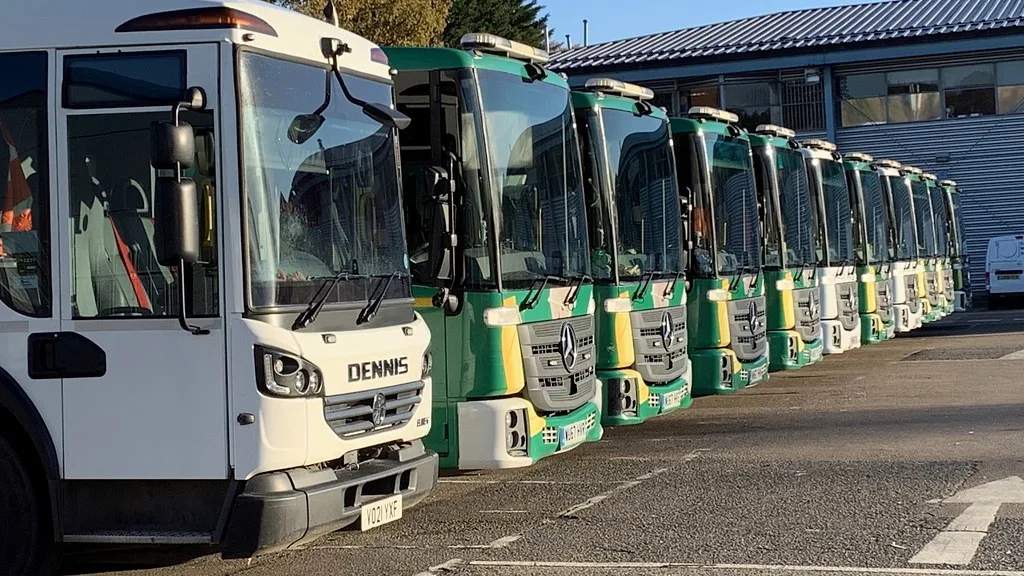

Amey is leaving the waste market, so Woking's bins pass to a new contractor in June 2027. The council has committed £4.2m towards a replacement lorry fleet.
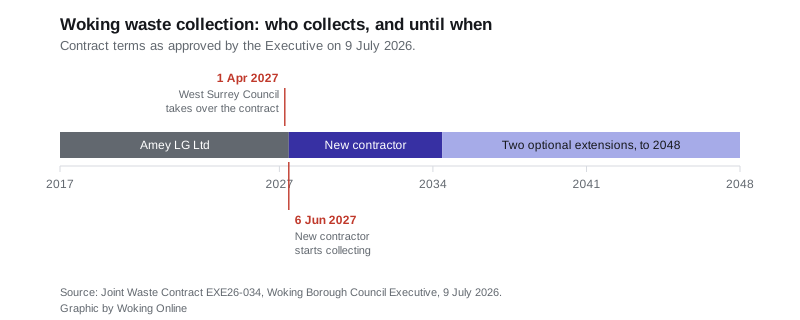
Woking’s bins will be emptied by a different company from Sunday 6 June 2027. Amey LG Limited, which has collected them for a decade, has chosen to leave the waste market and did not want to extend, so the four councils it serves have bought a replacement service through a joint procurement.
The winner has not been named in public. Woking’s Executive approved the award on 9 July 2026 in terms that refer only to “the Preferred Bidder”, with the price and the company held in confidential appendices (decision record).
Everything else about the deal is on the record, in a 20-page report by the council’s Head of Environmental Services (Joint Waste Contract EXE26-034).
The shape of the contract
- It starts on 6 June 2027, the day after the Amey contract ends, and runs to 5 June 2034
- Two further extensions are possible, up to a maximum contract length of 21 years, taking it to 2048
- It covers about 190,000 households across Elmbridge, Mole Valley, Surrey Heath and Woking
- Woking is drawing down £4.2m from its capital programme to buy the replacement lorry fleet
- Part of the council’s Monument Road depot will be leased to the new contractor from 6 June 2027
The report is blunt about why the initial term is only seven years, when the Amey contract ran ten. A shorter term would not have attracted bidders, it says, and seven years gives the incoming unitary councils more room to change direction later.
What changes for residents
The core service stays as it is. Rubbish, dry mixed recycling, food waste, chargeable garden waste, clinical waste and chargeable bulky waste all continue. Street cleansing is not in Woking’s part of the contract; the borough handles that through its separate grounds maintenance arrangement.
Three things do change.
The call centre moves to Surrey. Amey currently runs the waste contact centre for Woking and Surrey Heath from a national centre in Liverpool. The new contract requires it to be operated from within Surrey, so that the contract management office can watch its performance more closely.
Small electricals become bookable. At the moment small electrical items, batteries and textiles are collected in cages slung under the collection lorries. The report accepts that the cages fill up and residents’ items are not always taken. The new contract replaces that with a bookable collection using spare capacity on other vehicles.
The fleet stays diesel for now. Councillors pressed officers on electric lorries at the Environment and Place Scrutiny Committee on 7 July. They were told that depot charging capacity, power supply and space are the obstacles, that smaller electric supervisor vehicles will be used, and that the contractor must produce an annual carbon action plan. Hydrotreated vegetable oil is available as a drop-in fuel option if the councils choose to pay for it.
The option nobody has taken yet
The contract also prices a set of changes the councils could switch on later without going back to the market. One of them is three-weekly rubbish collections in all four areas. Nappy and hygiene product collections and recycling bring-site collections are priced in the same way.
The report is clear that these are options with a price attached and that there is “no obligation” to introduce any of them. No decision has been taken, and after 1 April 2027 that decision would rest with West Surrey Council rather than Woking. It is worth knowing the price is already agreed, because that removes one of the usual obstacles to making the change.
Another change is less visible but affects what Woking pays. Under the Amey contract, unit prices are the same across all four boroughs. Under the new one, each service is priced by area, reflecting the different costs of running from the depots at Camberley, Dorking, Esher and Woking.
What it means for you
Nothing changes on your bin day before June 2027, and the council says continuity through the handover is a contractual requirement, backed by a contingency mobilisation plan. Our regular guide is at Woking bin collection days.
Two points are worth noting. The contract transfers automatically to West Surrey Council on 1 April 2027, two months before the new contractor starts work, so the final stretch of the handover will be run by a council that does not exist today. And once the contract is signed, no single authority can walk away from it during the initial seven years. The four councils are jointly and severally liable to the contractor, as they are under the Amey contract.
The name of the company is likely to be published once the award is complete. Surrey Heath Borough Council, one of the four partners, said in July that the successful bidder would be announced after that point and that mobilisation would begin immediately (Surrey Heath Borough Council). Woking Borough Council has published nothing about the award in its own newsroom.
The competition was not a thin one. Seven bidders submitted an initial questionnaire, six met the conditions of participation, and five went through to dialogue after one withdrew for lack of capacity. Five submitted initial bids and the three highest scoring were taken to a final round. Price and quality were each weighted at 45 per cent of the assessment, with social value making up the remaining 10 per cent.
Update, 2 September 2026: the winner has been named. Joint Waste Solutions and Woking Borough Council confirmed on 1 September that the contract goes to Veolia. The councils’ contract award notice, published on Find a Tender on 3 August, puts the value at £632,337,262 including VAT over the full 21-year term and names Biffa and Suez as the unsuccessful bidders. Our report: Veolia to run Woking’s bins.
Have your say