
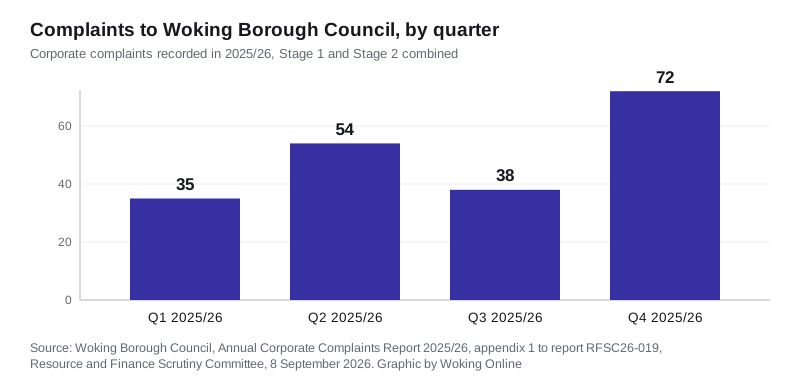
Complaints to Woking Borough Council rose from 35 in the first quarter to 72 in the fourth, and the council says AI tools may be part of the reason.
Complaints to Woking Borough Council more than doubled over the course of last year. The council logged 35 in the first quarter of 2025/26 and 72 in the fourth, according to its own annual complaints report, which was on the agenda for the Resource and Finance Scrutiny Committee on Monday 8 September (RFSC26-019).
Across the four quarters the charts in the report record 199 complaints in total.
The council offers three explanations for the rise, and the third is unusual to see in a council paper. Volumes went up, it says, because of “improved staff awareness of the complaints process, the inclusion of contractor-related complaints within the corporate complaints procedure and, potentially, the growing use of AI tools to prepare complaints” (appendix 1).
Where the complaints came from
The report’s service breakdown, which it labels indicative, puts three services well clear of the rest:
| Service | Complaints |
|---|---|
| Housing | 57 |
| Revenues and Benefits | 49 |
| Environmental Services | 45 |
| Planning | 22 |
| Other | 7 |
| Leisure and Communities | 6 |
| Customer Services | 5 |
| Property | 4 |
| Legal | 4 |
Each of those three has its own recurring theme, and the council names them.
In Housing, the theme is time spent in temporary accommodation. Those complaints are usually not upheld, the report says, because officers are found to have followed the correct process. It adds that they “highlight the impact of wider housing pressures within the borough”.
In Revenues and Benefits, most complaints are resolved by explaining a policy or a piece of legislation, and most are not upheld.
In Environmental Services, the majority are about waste collection: “repeated missed bin collections, delays to collections or damaged bins”. Bringing contractor complaints inside the corporate process is what gave the council sight of these, and it is also part of why the totals rose. If your collection has been missed, the reporting route and the current round dates are on our Woking bin collection days page.
Upheld complaints tripled between two quarters
The council only began recording outcomes in the third quarter, so there is one comparison available rather than a year of them. For Stage 1 complaints:
- not upheld: 18 in Q3, 27 in Q4
- partially upheld: 8 in Q3, 9 in Q4
- upheld: 4 in Q3, 13 in Q4
The council asks for that jump to be read alongside the overall rise in volumes. Where complaints are upheld or partly upheld, it says the cause is usually “issues with communication and customer experience”.
Response times moved the other way, which is the clearer good news in the report. The average Stage 1 reply fell from 15 working days in Q3 to 12 in Q4, against a 20 working day target, and that happened while volumes were climbing. Stage 2 went from 15.6 working days to 16.
The council has since set a tougher 10 working day target for Stage 1. In the first quarter of 2026/27, outside the period this report covers, it says the average came down to 7 working days.
What the Ombudsman found
Residents who are unhappy with the council’s final answer can go to the Local Government and Social Care Ombudsman. Its published figures for Woking in the year to 31 March 2026 are small in number:
- 17 complaints and enquiries dealt with
- 6 were not for the Ombudsman or were not ready to be looked at
- 8 were assessed and closed
- 3 were investigated, and 2 of those were upheld
That is a 67% uphold rate on investigated cases, against an average of 74% for similar authorities. In one of the two upheld cases the Ombudsman found the council had already put things right before the complaint reached it, a 50% satisfactory remedy rate where the average for similar councils is 15%. The council complied with recommendations in the one case where compliance was recorded, and did so on time (Ombudsman).
The Ombudsman’s annual review letter to the council, dated 20 May 2026, raised no themes or issues needing further action (appendix 4a).
Where the council still marks itself down
Officers score the council each year against the Ombudsman’s Complaint Handling Code. Six of the eight areas moved up to a full “Yes” in 2026. Two did not:
- Resources: “No” in 2025, “Partially” in 2026
- Stage 2 compliance: “Partially” in both years
The priorities the committee was asked to endorse for 2026/27 are meeting the new 10 working day Stage 1 target, reducing avoidable escalation to Stage 2, analysing complaint themes more closely, and strengthening resources.
What it means for you
If you complain to the council, you now have a published standard to hold it to. Stage 1 should be answered within 10 working days, and the council’s own recent average is 7. If it slips, that is worth saying in writing.
Complaining is also more likely to change something than the raw uphold rate suggests. The report is explicit that most upheld cases turn on communication rather than the underlying decision, so a complaint about being left in the dark stands a better chance than one asking for a decision to be reversed.
Bin complaints are now counted even when the contractor is at fault, which was not the case before. That is why waste sits third on the list, and why the council can see the pattern at all.
There is a deadline of a different kind coming. Woking Borough Council is abolished on 31 March 2027, and the report says the team is already working with colleagues across Surrey on moving complaints handling to West Surrey Council. Complaints made close to that date will be finished by a body that does not exist yet.
The full papers are on the committee agenda.
Have your say