
The government settled an £8 million Woking loan on 1 September, the first of £500 million it repays by March 2027. The borough owes about £2.2 billion.
Money has actually moved. On 1 September the government settled an £8 million loan on Woking Borough Council’s behalf, the first repayment of a £500 million package promised last October. The council announced it on 4 September. A further £492 million of loans will be repaid by the end of March 2027 (Woking Borough Council).
That is a large number. It is also less than a quarter of what the council owes.
What the council owes, and what £500 million does to it
The borough’s debt is about £2.2 billion. The figure appears throughout the council’s own General Fund budget report, approved by full Council on 2 March 2026, which describes “the size and scale of the historic debt at c.£2.2 billion”.
The same report is blunt about what the £500 million achieves:
This welcome support is expected to reduce the Council’s debt down to c.£1.7bn. However, even at this lower debt level, associated interest and Minimum Revenue Charges clearly remain elevated.
So the repayment is real, and the problem survives it. The report adds that even after the £500 million, “the value of the associated assets is materially less than the debt” (Woking Borough Council, General Fund Budget and Council Tax Setting 2026-27).
The debt costs more than the council does
The clearest way to see the scale is the council’s own forecast budget for this year. Set the cost of the debt against the cost of everything the council actually does.
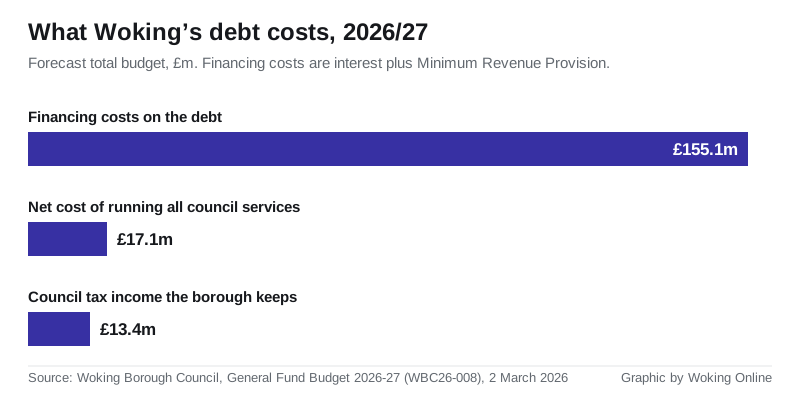
Financing costs, meaning interest plus the Minimum Revenue Provision the council must set aside to repay borrowing, come to £155.1 million in 2026/27. The net cost of running every service the borough provides is £17.1 million. Council tax income is £13.4 million.
Interest alone is projected at £62.6 million this year. The council’s Core Spending Power, the standard measure of what it has to spend, is £21 million.
Where the money is coming from
The £500 million was announced by the Ministry of Housing, Communities and Local Government on 28 October 2025, alongside its decision to replace Surrey’s councils with two unitary authorities. It was described then as “an initial tranche”, and it was made conditional on the council getting on with selling assets (Woking Borough Council).
It is not the only support Woking is getting this year. In February the government confirmed Exceptional Financial Support for 2026/27, made up of:
- a capitalisation direction of up to £58.1 million, which lets the council treat day-to-day costs as capital spending
- agreement to defer £92.09 million of the Minimum Revenue Provision charge it would otherwise have to make
The government’s letter said this reflects its recognition that the council “has no reasonable means of meeting all its current debt liabilities without assistance” (Woking Borough Council). Together those two items are the £150.2 million of Exceptional Financial Support recorded in the budget report, against £171.1 million the year before.
Cllr Ann-Marie Barker, Leader of Woking Borough Council, said the first repayment “marks a significant step towards addressing the council’s historic debt burden”, while adding that “there is still much work to do”.
What it means for you
Your council tax bill does not fall. The debt is not funded from council tax and repaying it does not reduce the bill. Woking Borough Council’s own share of a Band D bill this year is £307.05, up 3.00%. That is 11.82% of the £2,598.04 total. Surrey County Council takes £1,938.42, or 74.61%, and the Police and Crime Commissioner £352.57. The full breakdown is on our Woking council tax bands page.
Services are funded from a separate, much smaller pot. The business-as-usual budget for mainstream council services is £22.0 million for 2026/27, down from £23.6 million. The council says it can balance that budget this year without exceptional support, but forecasts a £6.0 million shortfall on it in 2027/28.
The problem outlives the council. Woking Borough Council is abolished in April 2027 and replaced by a West Surrey unitary authority. About £1.7 billion of debt will still be outstanding. The budget report says the government has committed to keep working with the council and its commissioners on the long-term position, and that “this work will continue beyond the new unitary council’s vesting day”.
Watch the asset sales. The £500 million is tied to progress on the asset rationalisation programme. Every building the council sells is part of the condition attached to the money. We track the town centre schemes on our Woking planning news page.
Sources
- Woking Borough Council: Government begins repayment of Woking’s historic debt, 4 September 2026 (the 1 September £8 million settlement, the £492 million to follow by end of March 2027, and the Leader’s comments)
- Woking Borough Council: Government announces significant debt relief for Woking, 28 October 2025 (the £500 million commitment, and the asset rationalisation condition)
- Woking Borough Council: Government confirms Exceptional Financial Support for 2026/27, 24 February 2026 (£58.1 million capitalisation direction, £92.09 million MRP deferral, and the quoted line from the government’s letter)
- Woking Borough Council: General Fund Budget and Council Tax Setting 2026-27 (WBC26-008), Council, 2 March 2026 (c.£2.2 billion debt, reduction to c.£1.7bn, £155.1 million financing costs, £17.1 million net cost of services, £13.4 million council tax income, £62.6 million interest, £21 million Core Spending Power, £22.0 million business-as-usual budget, £6.0 million 2027/28 shortfall, £150.2 million and £171.1 million Exceptional Financial Support, and the Band D council tax table)
Have your say