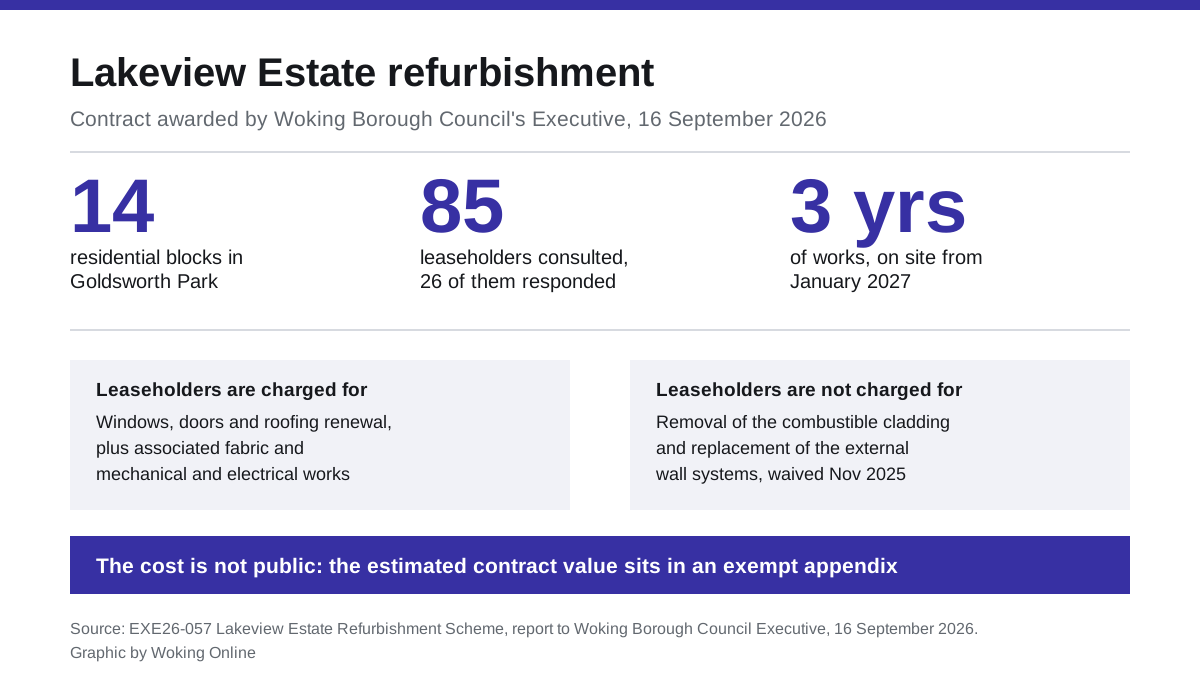

Woking has awarded the contract to refurbish 14 Lakeview blocks. Cladding costs are waived, but windows, doors and roofs are recharged. The bill is exempt.
Woking Borough Council has awarded the contract to refurbish 14 blocks on the Lakeview Estate in Goldsworth Park, two years after combustible cladding was stripped from them. Eighty-five leaseholders will be recharged for part of the work. Nobody outside the council knows yet how much they will pay, because the estimated contract value sits in an exempt appendix that was not published.
The Executive took the decision on 16 September. It also asked for a second report, on whether those leaseholders should get more help paying, and that is expected on 12 November 2026 (Woking Borough Council, decision record).
The council’s own report is blunt about the position it has put residents in. It says the works are substantial and “that the estimated charges may be significant for some leaseholders” (EXE26-057, Lakeview Estate Refurbishment Scheme).
What is being charged, and what is not
This is the part that decides the size of the bill. In November 2025 the Executive agreed to waive the cost of the cladding removal and the external wall system replacement, even though it was entitled to recharge those too. Everything else counts as “qualifying works” and is recharged in line with the leases.
So leaseholders are being asked to pay for:
- replacement windows
- replacement doors
- roofing renewal works
- other associated building fabric and mechanical or electrical works
They are not being charged for:
- the removal of the combustible cladding
- the replacement of the external wall systems
The council confirms it has “exercised its discretion not to charge for works in connection with cladding removal and external wall systems replacement”.
Why the work is happening
The cladding came off the 14 blocks in 2024, after a fire risk assessment. What went on instead was never meant to last. The report describes a temporary external covering and insulation system installed to keep the buildings weatherproof and warm, “designed only as an interim measure” with a limited lifespan that “has already required some remedial works”.
The rest of the estate has aged alongside it. Roof coverings, windows and doors are “showing widespread defects”, causing poor thermal performance, water ingress and higher maintenance costs.
The council’s stated reason for the decision is to fulfil its statutory duties for resident safety and building compliance, and to keep the buildings habitable “through replacement of temporary fire safety measures with permanent solutions”.
Doing nothing was considered and rejected. The report says the temporary measures “will fail within a short period, leading to uninhabitable homes, resident safety risks, and escalating costs”.
The contractor has not been named
Ten firms submitted compliant tenders, from twelve expressions of interest. The winner was picked through a mini-competition on the London Construction Programme Housing Major Works framework, and scored on quality and cost at 50% each.
The margin was one percentage point, and the winner did not have the best bid on either measure taken alone:
| Rank | Quality score | Price score | Total |
|---|---|---|---|
| 1 (preferred bidder) | 31% | 48% | 79% |
| 2 | 32% | 46% | 78% |
| 3 | 36% | 41% | 77% |
| 4 | 23% | 45% | 68% |
| 5 | 17% | 50% | 67% |
The third-placed bidder scored highest on quality, at 36%. The fifth-placed bidder scored highest on price, at 50%. The firm that won came third on quality and second on price, and took the contract on the combined total.
The council has not published the winner’s name. The report says the detail is “set out within the confidential appendix”. Leaseholders themselves have seen more than the public has: the report records that they “have been able to view the preferred contractor’s tender documentation” and that no queries were raised about the contractor’s ability to do the work.
What the consultation said
The council served a Section 20 Notice of Proposal on the 85 affected leaseholders on 23 July. The consultation ran to 24 August. Weekly drop-in sessions were held on 30 July and on 6, 13 and 20 August.
Twenty-six leaseholders responded. The council groups their points into six themes:
- pricing, billing and affordability, including how costs were calculated and what financial help is available
- the surveys carried out and the methods behind them
- justification for specific items in the scope of works
- evaluation and decision making, including value for money and access to documents
- communication and governance, including assurance on quality and cost
- queries specific to individual properties
What it means for you
If you own a leasehold flat on the Lakeview Estate:
- Nothing is payable yet. The report states that no charges “are expected to become payable until works affecting the leaseholder’s block have been completed”. The programme runs block by block over about three years, so the timing of your bill depends on your block’s phase.
- The repayment period may be about to get longer. The council’s Major Works Repayment Options Policy currently allows five years. As part of the consultation it asked leaseholders what they thought of extending that to up to ten years for those eligible. That is one of the things the 12 November report is expected to cover.
- A Notice of Reasons is coming. It has to be sent within 21 days of the contract being awarded, so by early October. It names the chosen contractor, explains why it was chosen, and summarises the consultation responses and the council’s answers.
- The full list of queries and answers will be published to all leaseholders, according to the report.
For everyone else in the borough, the relevant point is the risk the council has taken on. The report warns that leaseholder contributions “may be legally challenged or contested”, and that if recovery fails, “the Council could be liable for meeting the full cost of the works”, which would land on the Housing Revenue Account.
The timetable
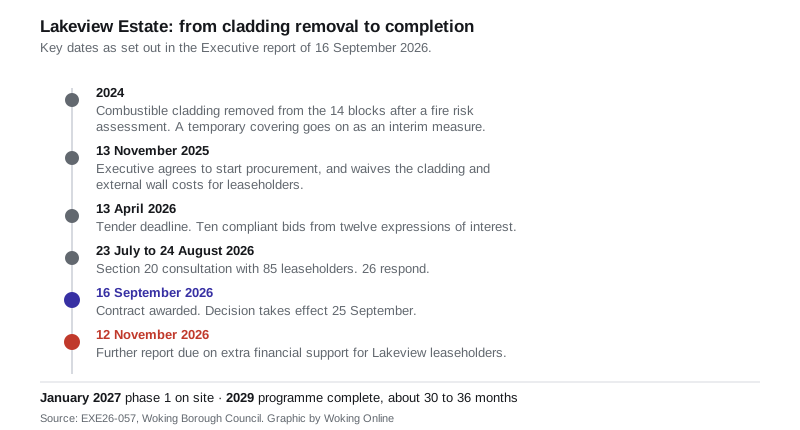
Mobilisation of the first phase was due to begin in late September 2026. Full commencement of phase 1 on site is expected from January 2027. It is a three year programme, running roughly 30 to 36 months across the 2026 to 2029 financial years, with blocks done in phases according to a priority assessment. A full works schedule will be developed and published once the contractor is approved.
The planning consent for the external work was granted under application PLAN/2025/0682, which the report says covers the elevations, materials and detailing and formed the basis of the tender specification. More local cases are in our Woking planning applications guide.
The works will outlive the council
Woking Borough Council is abolished on 1 April 2027, part way through phase 1. The report addresses this directly. It concedes “an element of risk that the decision to refurbish the affected blocks may not be in accordance with the plans of a new unitary authority”, then says that because the project arises from fire safety risks, “it is imperative that this work is commissioned and progressed ahead of LGR”.
West Surrey Council will inherit the contract, the leaseholder charges and the unfinished blocks. We covered the handover in our report on Woking’s closure going ahead despite the national pause.
The decision was open to call-in. It takes effect on 25 September, and the call-in count stood at zero when the record was published.
Frequently asked questions
How many homes are affected?
The scheme covers 14 residential blocks on the Lakeview Estate in Goldsworth Park. Eighty-five leaseholders were formally consulted on the proposed recharges. Council tenants in the blocks are not recharged for major works in the same way.
How much will leaseholders have to pay?
The council has not published a figure. The estimated contract value is in an exempt appendix, and individual charges follow from it. The report acknowledges the charges “may be significant for some leaseholders”. A further report on additional financial support is expected at the Executive meeting on 12 November 2026.
Are leaseholders paying for the cladding?
No. The Executive agreed on 13 November 2025 to waive the costs of the cladding removal and the external wall system replacement, although it was legally entitled to recharge them. Windows, doors, roofing and other qualifying works are recharged.
When do the works start?
Mobilisation of phase 1 was due in late September 2026, with full commencement on site from January 2027. The programme is expected to take about 30 to 36 months, finishing in the 2028-29 financial year.
Who won the contract?
The council has not said. The report names only “the highest scoring tenderer” through the London Construction Programme Housing Major Works framework, with the identity in a confidential appendix. A Notice of Reasons naming the contractor must be sent to leaseholders within 21 days of the award.
Sources
- Woking Borough Council: Lakeview Estate Refurbishment Scheme, decision record EXE26-057, decision 16 September 2026, published 17 September, effective 25 September (resolution text, reasons, ward, call-in count)
- Woking Borough Council: EXE26-057 report to the Executive, published 8 September 2026 (14 blocks, 2024 cladding removal, tender scores, 85 leaseholders, 26 responses, Section 20 dates, waived cost elements, repayment options, programme dates, 12 November report, LGR risk)
Figures and dates in this report come from the council’s own published report and decision record. The estimated contract value and the contractor’s identity are held in an exempt appendix and are not public. Checked against the sources above on 20 September 2026.
Have your say